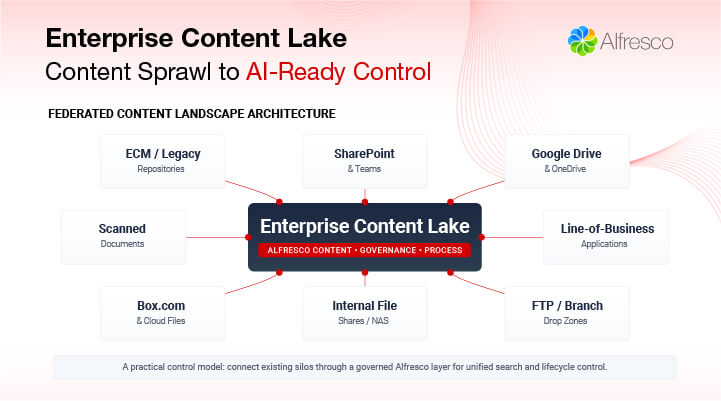
Governed, AI-enabled Enterprise Content Lake + Case platform for banking. API-first integration
A single content lake with retention, audit, and metadata controls, enhanced by AI OCR, AI search, and AI summaries. Embed electronic and digital signing so approvals complete faster and signed PDFs become governed records. Standardize API security with Kong Enterprise, and StackGuard.
Standard APIs + policies, consistent content services, and predictable case orchestration for application modernization.
Metadata-driven content lake and federated document management, lineage-ready audit trails, and retention-driven lifecycle controls.
Self-hosted deployment in public and private cloud of your choice, sovereignty alignment, and an enterprise backbone for regulated change.
Most banks have strong core systems – but content, evidence, and workflows are fragmented across channels and vendors. The result: duplicated KYC packs, inconsistent approvals, audit evidence gaps, and uneven digital security controls. Slow cases often stall on signature turnaround and manual handoffs.
Start with the backbone (content + records), then accelerate time-to-yes for customer journeys and digital channels.
Create an enterprise content lake for banking: unify documents, records, metadata, and lifecycle controls across systems—self-hosted for residency and sovereignty.
Store signed artifacts as governed records with retention and audit trail.
Automate evidence-heavy banking cases with end-to-end visibility: onboarding, loan origination, card applications, disputes, remediation, and service requests.
Add signature steps for key milestones (consent, offers, agreements) to reduce turnaround.
Modernize and secure web/mobile applications using Kong Enterprise API Gateway—standardize authN/authZ, traffic policies, and observability across teams.
| Persona | Primary wins | How it's delivered |
|---|---|---|
| Application Architect | Standard policies, fewer one-off security designs, faster delivery | Kong policy templates + content APIs + repeatable case flows |
| Data Architect | Unified metadata, governed lifecycle, audit-friendly lineage | Content lake taxonomy + retention schedules + auditable actions |
| CTO / CIO | Sovereignty-ready platform strategy, lower risk, scalable governance | Self-hosted Alfresco + Kong; phased delivery with measurable controls |
A pragmatic banking pattern: Kong standardizes API policy and traffic controls at the edge, while Alfresco provides governed content/records and the evidence spine for case processing. Digital signing integrates as a workflow step; signed outputs are retained as governed evidence.
Use Alfresco as the enterprise content lake backbone: governed storage, metadata, audit, retention, and integration APIs – enhanced with AI OCR extraction, AI-assisted search/insights, and AI summaries stored as governed metadata/notes.
Define lifecycle rules that manage records until destruction or transfer, supporting policy-driven retention and disposition.
Comply to industry standards such as ISO 167175, ISO 15489 and Central Bank guidelines.
Audit views support external audits and internal verification, while REST APIs expose audit applications and logs, enabling SIEM integration and governance reporting.
audit evidence + SIEM
Enable paperless processes by integrating Alfresco workflows with digital signing solutions such as SignDex route documents for signature, track status, and store signed artifacts as governed records with auditability.
paperless execution
Consolidate evidence from capture/upload/email/integrations with cloud drives such as OneDrive, SharePoint, Teams, Google Drive or Box etc, into a governed lake while keeping a consistent policy model.
content lake
Combine full-text and metadata discovery with AI-assisted search to surface insights from documents, summaries, key entities, and relevant evidence, accelerating investigations and case resolution (within access boundaries).
Bring your own self-hosted or cloud based Large Language Model (LLM) to power the AI capabilities.
findability + insights
These controls (retention schedules, audit evidence, and audit APIs) are commonly used to support PDPA/GDPR and banking governance programs, but final compliance depends on your policies, configuration, and operating model.
Cases are where banking risk lives: evidence, approvals, exceptions, and SLAs. Case management keeps humans in control, but eliminates manual chasing and undocumented decisions. Reduce cycle time by embedding signature steps into onboarding, loan, and card milestones.
| Case | Queue | Status | SLA | Next action |
|---|---|---|---|---|
| Onboarding-10491 | KYC Review | Ready | 3h | Approve risk |
| Loan-88302 | Underwriting | In Progress | 1d | Request payslip |
| Card-22015 | Compliance | Exception | 6h | Resolve mismatch |
Standardize security and traffic policy at the edge, reduce risk and accelerate digital modernization.
zero-trust posture
SSO standardization
resilience control
policy reuse
consistent enforcement
governance at scale
| Track | Scope | Typical outcomes | Trade-off |
|---|---|---|---|
|
V1-A (Fastest viable)
|
1 content domain (e.g., Onboarding), 2–3 sources, 1 case type, Kong policies for top 10 APIs (option: include a SignDex signing step in V1 if approvals are the bottleneck) | Working content lake + case + standardized API policy within a single journey | Not "enterprise-wide" yet; federation expands iteratively |
|
V1-B (Robust program)
|
Multi-domain taxonomy, enterprise retention model, SIEM integration, case portfolio, Kong platform governance (templates/guardrails), and standardized paperless signing patterns across journeys | Bank-wide governance backbone + repeatable modernization factory | More stakeholder alignment and operating model work |
federation • retention • audit
SLA • exceptions • evidence
mTLS • OIDC • rate limits

Request for information or schedule a solution demo.