Alfresco ADF is powerful — and notoriously complex. Between its sprawling component library, ECM/BPM integrations, and Angular-specific quirks, developers often lose hours hunting through sparse documentation. Claude AI can dramatically accelerate your workflow if you know how to prompt it well.
01 Understand What Claude Knows About ADF
Before diving in, calibrate your expectations. Claude has solid knowledge of Alfresco Application Development Framework (ADF) including its Angular-based components for document management, process management, and content services. It understands the ADF component library (DocumentList, TaskList, SearchBar, etc.), ADF services, and how they connect to Alfresco Content Services (ACS) and Alfresco Process Services (APS).

02 Scaffold ADF Components Quickly
One of the most time-saving uses of Claude is generating boilerplate for ADF components that would otherwise require you to trace through documentation. Instead of asking vague questions, be explicit about your context.
❌ Weak Prompt

✅ Strong Prompt

Claude will generate a well-structured Angular component with the right ADF imports, column definitions, and service injections.
03 Debug ADF Configuration Issues
ADF’s app.config.json and AuthenticationService setup can be tricky, especially when integrating with SSO (Keycloak) or switching between Basic Auth and OAuth2. Claude excels at diagnosing configuration mismatches when you provide the actual config.
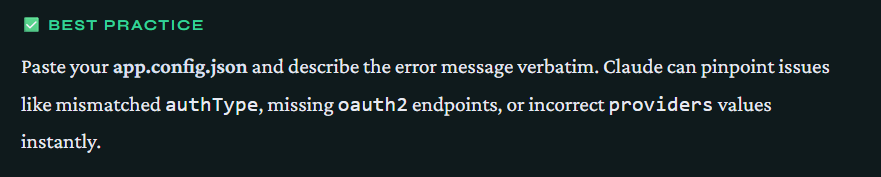
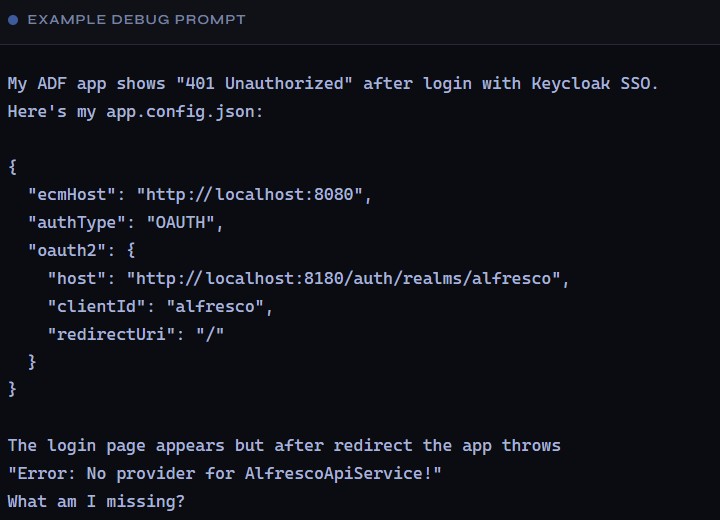
Claude will identify that CoreModule.forRoot() or the required ADF module imports are missing from AppModule, and walk you through the exact fix.
04 Generate ADF Process & Task Integrations
Alfresco Process Services (APS) integration — task lists, forms, process instances — is where many developers struggle. The ADF Process Services library has a steep learning curve. Use Claude to generate working integrations by providing clear context about your process definitions.
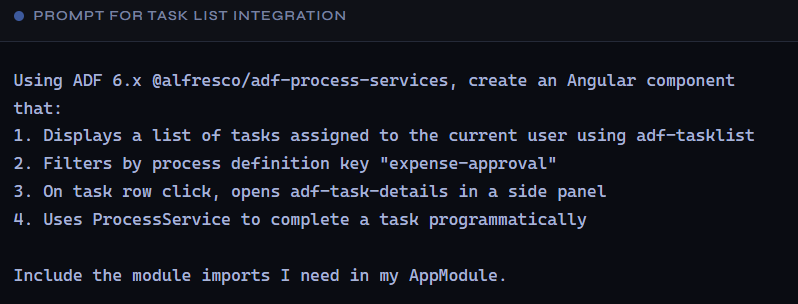
Claude will generate both the component and the required NgModule imports — saving you from digging through ADF source code to find the right module names.
05 Work with ADF Content Models & Custom Aspects
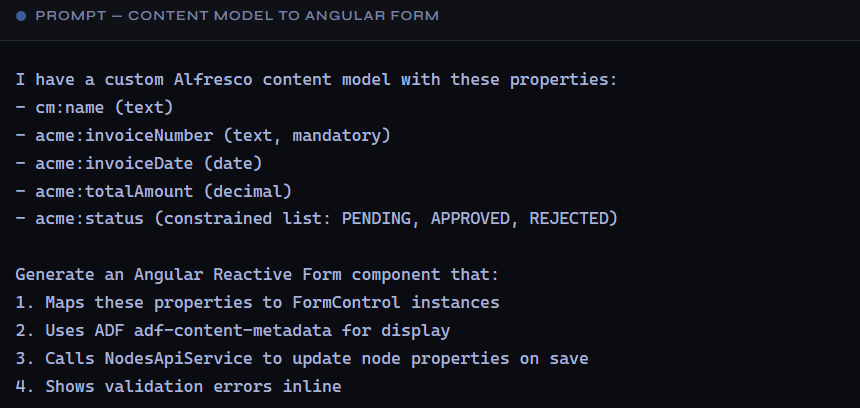
Alfresco’s content model (custom types, aspects, properties) is central to enterprise ACS deployments. Claude can help you map Alfresco content model properties to ADF form fields and Angular reactive forms.
06 Write Efficient Unit Tests for ADF Components
Testing ADF components can be awkward because of all the module dependencies and service mocks needed. Claude can generate test suites that properly mock ADF services like AlfrescoApiService, AuthenticationService, and NodesApiService.
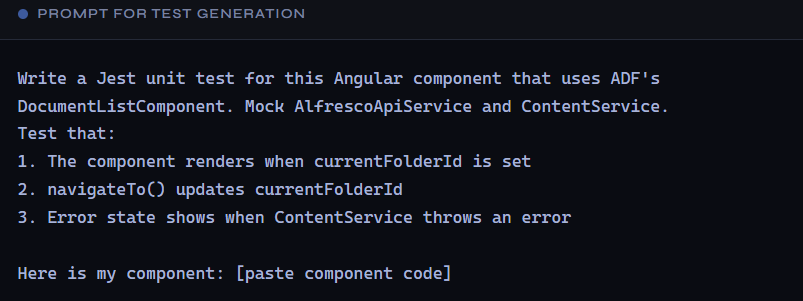
Claude generates a full TestBed setup with proper provider mocking, spies on ADF services, and async test patterns using fakeAsync and tick().
07 Optimize Your Prompting Strategy
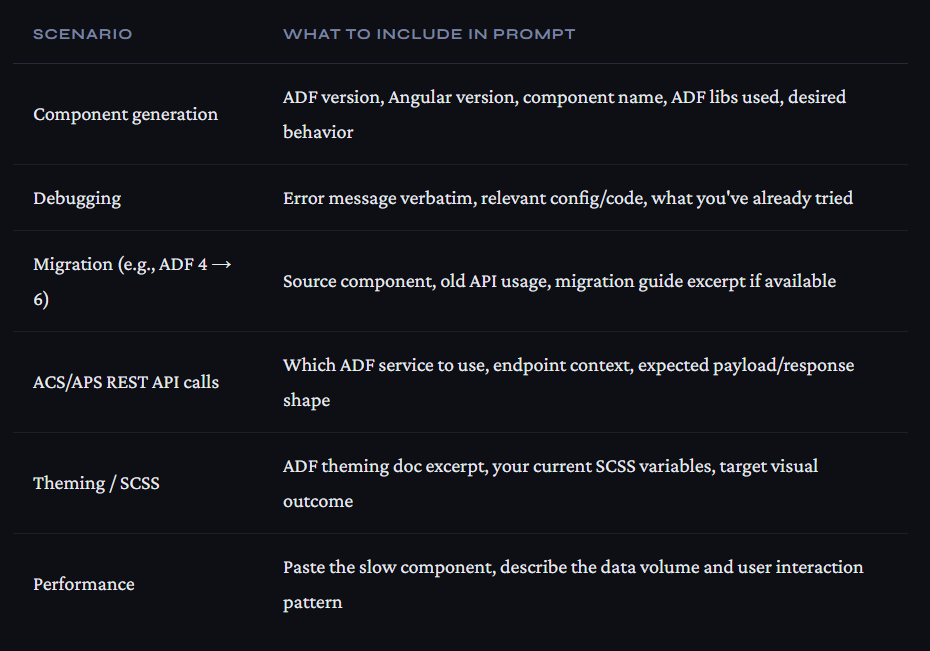
The quality of Claude’s output scales directly with the quality of your prompt. Here’s a reference table for prompting patterns tailored to ADF development:
08 Use Claude for ADF Version Migrations
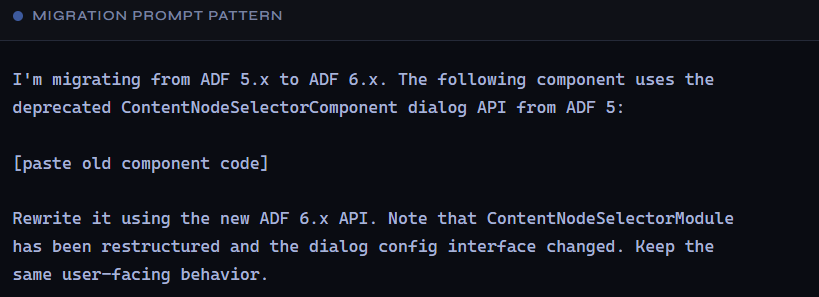
Migrating between ADF major versions (e.g., ADF 5 to ADF 6) involves breaking API changes, removed components, and module restructuring. Claude is highly effective at this when you provide concrete before/after context.
09 Leverage Claude for ADF Documentation Gaps
ADF’s official documentation has notorious gaps, especially for advanced use cases, undocumented component inputs, or integration patterns. Claude can fill these gaps — but be strategic.
When documentation is absent, ask Claude to reason from source code patterns:
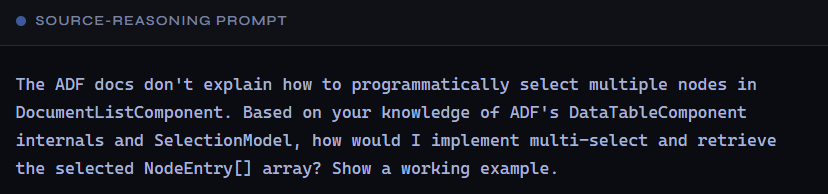
This kind of prompt leverages Claude’s understanding of Angular CDK patterns that ADF builds upon, producing answers even when official ADF docs are silent.
10 When Claude Has Limitations
Be aware of situations where Claude’s output needs careful verification:
Very recent ADF releases: If Alfresco released a new ADF version after Claude’s training cutoff, API details may be outdated. Always cross-check with the official changelog at github.com/Alfresco/alfresco-ng2-components.
Proprietary ACS configurations: Claude doesn’t know your specific Alfresco server setup, custom models, or enterprise configurations. Provide these explicitly in your prompts.
Complex BPMN/APS processes: For intricate process engine configurations, treat Claude’s output as a starting point and verify against Alfresco Process Services documentation.
Conclusion
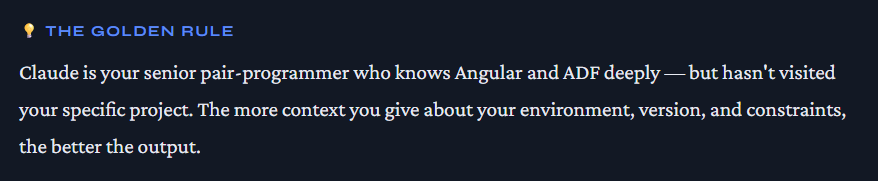
Claude AI is not a replacement for your expertise as an Angular + Alfresco ADF developer — it’s a force multiplier for it. The developers who benefit most aren’t those who blindly trust every generated line of code, but those who use Claude as a knowledgeable pair programmer: one who understands Angular patterns, knows the ADF component library deeply, and can reason through ACS/APS integration challenges on demand.
Alfresco ADF is one of the more complex Angular ecosystems out there. With Claude as a consistent part of your toolkit, that complexity becomes far more manageable — leaving you free to focus on delivering business value rather than fighting with module registries and sparse documentation.